
Thread: Bolt head jumping track, wot, again? yup, fraid so
Retrieved: 06/05/2014
I know this topic is a bit worn out, but I looked over the previous posts and the consensus has been either accumulated wear or damaged receiver, and yet today I've been going over a 1943 Lithgow that appears neither, yet jumps the track when retracted about one inch.
The rifle has a green band, and in all other regards appears to have had very little use, because of this low use condition, ie near new rifling, blueing undamaged, all matching serials (5) etc, its being considered as a competing rifle, yet with several shots in the mag it tightens up on the second or 3rd one and ultimately the bolt head jumps the track and the bolt won't draw back any further, its tight.
The bolt head can be forced (gently) over the track by hand.
The track blueing shows very little wear, and no sign of dents or hits on the receiver anywhere.
I just thought the whole thing really odd considering the unused condition of the rifle.
Doesn't the green band indicate a cadet rifle that would have had regular but light use? It seems in keeping with the appearance of little aging, but if the rifle was jamming etc wouldn't they have flagged the rifle? There's no DP or other marks.
newcastle
03-12-2012
Mine (as mentioned in another thread) is similar but in storage right now so I can't get at it to check anything since that thread was open. Mine LOOKS pretty much unused but the bolt does have looser tolerances than other No1s I have and when the rear of the bolt is pushed to the left the bolt would, if it were upside down fall off the track.
RJW NZ
03-13-2012
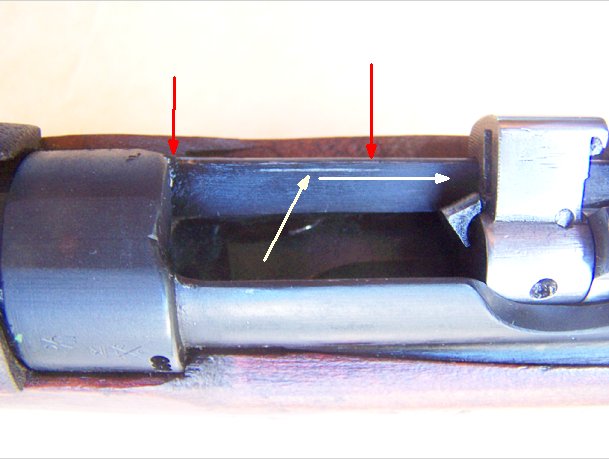
Here's a couple of pics. Regarding the red arrows, if I lay a straight edge on that plane, it is dished 2-4 thou and I can see daylight under the straight edge in the middle. The white arrow is pointing at a scratch mark which is the place where it comes free, forward and rearward of that area its OK.
Because the rifle is otherwise so good, with matching serial on the bolt, I'm inclined that the owner should try a few bolt heads and/or try building up the groove in the bolt head. Would there be any reason not to do this?

Thunderbox
03-13-2012
I find that an exchange of bolt head nearly always "cures" this problem.
I think that possibly the bolt track and bolt head groove might have been part of the tolerance relaxations during WW1 to ensure rifle functioning, and that this has led to a proportion of rifles/bolt heads not working together well due to normal manufacturing variations.
An elderly and highly experienced armourer/gunsmith told me that, on rifles that genuinely seemed to have an indented bolt track - they simply put a big cold chisel into the magazine well, and gave it a whack with a hammer! Obviously it wasn't seen as a problem that needed to condemn the rifle...
Peter Laidler
03-13-2012
This is a load of old clap trap, written before engaging brain. Read below for explanation.
There is only one thing that will cause a spring loaded No.4 bolt head to jump out of the track and that is if the firing pin spring is twisting the bolt head in a anticlockwise direction while it is running along its path. When it does start to lift at the track opening, that's when it chips away at the edge and the real problems start
The same directional force theory applies to SMLE bodies except that it is exaggerated by wear on the underside of the bolt head or the outside of the track. EY rifles suffer from bowing of the right hand bodyside. I'd start by making sure that there are no sharp edges at the start and end coil of the striker spring.
Peter Laidler
03-13-2012
Oops... I just hope nobody's read the above totally absurd answer wot I wrote! I was thinking of something totally different and engaged mouth before putting brain into gear... Bolt heads have nothing to do with spring torque or loading.
I was reminded within about 10 minutes by one of the Armourers over the road who'd been browsing the site who phoned me and said '...you're thinking about the SA80 ejection cover we were talking about...' Only he didn't say it as politely as that
bouletbill
03-13-2012
An old Sussex armourer told me it wasn't an uncommon problem... and suggested I (gently) hammer down the groove lip on the bolt head, to make it a tighter fit. This I never did because I just didn't like the idea (of hammering my gun) and anyway, it has only jumped track a couple of times in about 20 odd years. However, it is certainly not caused by any WWI tolerance issues... because my No.1 is a '39er.
Son
03-15-2012
I had a rifle here a few weeks ago with the same problem. It was in good condition, all except the bolt head- and it also failed headspace, by several thou! I surmised the bolthead might have been swapped to fix another rifle, fitted a new bolthead that headspaced good. The new bolthead was still able to be lifted off the track, but only in one spot.
I started measuring the diameter of the two boltheads and found the new one to be perfectly round, but the old one had a definite wear pattern that lined up with its contact on the receiver as if it were being held up as it cycled. I compared the bolt body with a newer one and found the same thing.
Putting the newer bolt body and new bolt head together in the rifle and it no longer was able to disengage, no matter how hard I lifted it! It appears to me that with a little bit of wear on the bolt head and bolt body, it is allowing it to move (firers view) up a little and it goes to the right, guided by the inside shape of the left receiver wall.
The wear on the bolt parts are mainly on the right because the contact area on the receiver is smaller on the right. This free play up and to the right lifts the bolthead out of the track.
Seems simple enough, but a question to people with the metallurgical knowledge... is the inside surface of the receiver harder than the bolt body?
tbonesmith
03-16-2012
I had the same problem on a '42 or '43 Lithgow range rifle, it did it with every bolt head I tried. I parted it out, the best part about it was the barrel anyway.
newcastle
03-16-2012
So on these rifles. What is the danger of the bolt head jumping the track? is it safe to fire when the bolt head is properly engaged? the reason I ask is because I fired this lithgow several times before I noticed this.
As far as I can see, if the head had moved up then the rifle will not load - correct? And as the rifle is "cock on closing" if it is not sliding into battery then the firing pin will not be cocked, and therefore there is zero risk of firing before the locking lugs have engaged and the bullet is properly seated? The biggest danger would be for instance if a German / Japanese / North Korean (insert as appropriate) was charging you with a fixed bayonet and the bolt head coming off the rail meant you could not fire the rifle. Am I wrong here?
Peter Laidler
03-16-2012
If the bolt head of the No.1 or the No.4 jumped out of the bolthead track while on its way forwards, then according to my skeleton action, the extractor would stub itself onto rear face of the barrel or onto the rear surface of the breeching up ring because being rotated slightly anti-clockwise, the extractor would miss the extractor slot. The breech wouldn't lock and the inbuilt mechanical safety would come into play.
newcastle
03-16-2012
So in other words, the bolt head rotation means that it CANNOT be fired in this situation and therefore when the bolt head is IN place it should be safe to fire (notwithstanding headspace, locking lugs and all the other stuff which needs to be in spec to have a safe Lee Enfield)
Bruce_in_Oz
03-16-2012
Bolt alignment is one of the few weaknesses in the Lee Enfield design as I see it.
The problem stems from the fact that there is very little to stop the bolt from floating up and down because the top and bottom of the raceway are cut away to allow passage of the locking lugs.
If you carefully watch as a bolt is being manipulated during firing, you will notice the following (tendencies):
As the bolt is withdrawn in the extraction/ejection stroke, most of the time you will see that the firer's hand causes it to tilt up at the rear.
Conversely, during the feed/chambering stroke, the operators hand tends to cause the rear of the bolt to tilt downwards.
This "see-sawing" has the effect of wearing the bolt body and the receiver in such a way that the problem can only get worse.
This vertical excursion thus also has an effect on the retaining nib of the bolthead, be it No.1 or No.4, because it too will rock up and down.
On a No.4 Mk1 or 2, with their continuous track, things have to get really flogged out before anything nasty happens. However, on the 1*, it doesn't take much wear to cause the bolt head to float around to the point where it will start to collide with the edges of the cutout in the rib on the receiver. One this starts to cause chipping, you are in real trouble unless you get a new bolt assembly AND can find someone who is good with a TIG welder and miniature grinders.
Another thing to note is that the vertical excursion of the bolt running over an empty magazine is quite different in nature from its behaviour when handling live or drill ammo.
Over the years I have noticed that many Mk1* rifles have little bevels on the upper surfaces of the end of the nib of the bolt head. This actually helps greatly to reduce damage to the receiver. However, I have yet to find documentary evidence of the origins and official (or otherwise) stature of this modification, even in the few Canadian workshop documents that I have seen.
Wear at the rear of the receiver also causes the SMLE bolt to float about. Couple that with wear or damage to the receiver rail and bolt head, and things start to get annoying.
One has to constantly keep in mind that these rifles were not exactly made yesterday, nor have they always been meticulously maintained, especially since they left their original service.
lngstrt
03-16-2012
I de-sporterized a 1940 Ishy last year that had/has this issue. With any upward pressure from 2nd etc. rounds in the magazine and the bolt head jumps the rail. If I go slow and hold the head down it's fine. Now, working an Enfield bolt slowly is no fun, but, shooting over a bench at paper I can barely see... it's fine. My Dad has had this rifle since the 70's and never fired it. I just had to make it look like a battle rifle again and... then I found the track jumping problem. Oh well, she looks like she's supposed to now.
Peter Laidler
03-17-2012
We regularly repaired hundreds of Mk1* and 1/3 rifles with chipped bolt head slots. It was quite easy and I detail the repair elsewhere if anyone is interested.
Like Bruce in Oz, I have noticed the little chamfer on the undercut of some bolt heads and again, I can find no mention of it in any official documentation, especially in our EMER bible.
On the point you make about the up and down rocking movement of a bolt being moved forwards B in O, this is almost academic in practice because onvce the bolt actually locks up it will centralise itself against the even locking lugs and sit absolutely squarely against the round in the chamber.
Any forumer wanting to test this, just blue the rear of the reject CHS gauge, slide it into the chamber and slowly close the extractor-less bolt and bolt head on it. You will (?) have the perfect circle of the gauge marked on the bolt head face.
In any case, a badly worn body that exhibited exaggerated bolt rock would have been picked up by the Inspectors calibrated bolt. Loose and the rifle was in for the chop!